What to Look for in a Time Tracking System
Published by - Mar 20, 2026
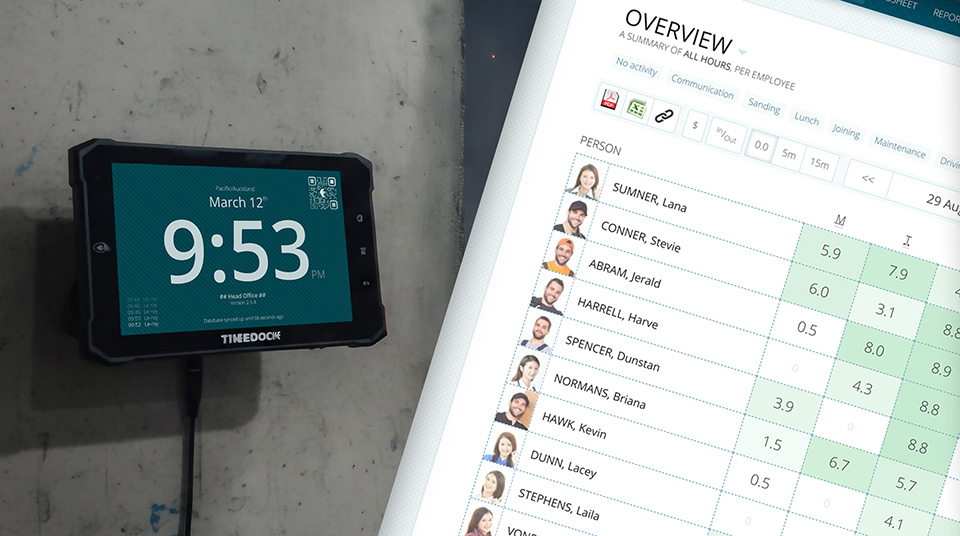
Once paper timesheets and spreadsheets start creating more admin than clarity, the next step is usually to look at time tracking software.
But not all systems are built for the same type of work.
Some tools are designed for office environments with fixed shifts. Others are built for mobile teams, job-based work, or multi-site operations. Choosing the right system depends less on features and more on how well it fits the way your business actually operates.
Here are the key things to look for when evaluating a time tracking system
1. Time should be captured as work happens
The most reliable systems capture time in real time, rather than relying on people to reconstruct their day later.
Look for a system that:
-
Makes docking in and docking out simple
-
Reduces reliance on memory and manual inputs later in the week
-
Creates consistent records automatically
If employees have to remember what they worked on at the end of the week, accuracy will always suffer.
2. It should reflect how your work is structured
Many businesses do not operate in one location or on one project at a time.
A good time tracking system should allow you to:
-
Allocate hours to specific jobs or projects
-
Track time by site or location
-
Separate different types of work where needed
Without this flexibility, businesses often end up forcing their workflow to fit the software rather than the other way around.
3. Provide visibility and control before payroll
It is also important to consider how time is captured and controlled.
Some systems rely entirely on individual devices, where employees simply dock in and dock out on their own phones with minimal structure. While convenient, this approach can result in:
-
Inconsistent records
-
Limited oversight
-
Difficulty verifying how time was recorded
A more structured system provides consistent capture methods, such as fixed devices, ensuring time is recorded in a defined and controlled way.
This creates centralized visibility for administrators, allowing hours to be reviewed and approved before they move into payroll or reporting systems.
Convenience matters, but consistency and oversight are what make time data reliable.
When managers can see and validate hours before payroll is processed, last-minute corrections are reduced and confidence in the data improves.
4. It should reduce admin, not add to it
Some systems introduce new complexity in the name of control.
A good time tracking system should:
-
Simplify how hours are recorded
-
Reduce manual checking
-
Remove or minimize manual data entry into payroll systems
-
Make reporting straightforward
If a tool requires constant maintenance, it may not solve the underlying problem.
5. It should work alongside your existing systems
Time tracking does not operate in isolation. Hours are often used for:
-
Payroll
-
Job costing
-
Reporting
-
Compliance records
Look for a system that can pass approved time data into your existing payroll or reporting systems without requiring major workflow changes.
Keeping your current payroll provider while improving time capture is often the most practical approach.
6. It needs to be practical for staff to use
Even the best system will struggle if it does not fit daily routines.
Consider:
-
How easy it is for staff to dock in and dock out
-
Whether it works across different environments
-
Whether it matches how people move between jobs or locations
If the system feels complicated, adoption will suffer, and accuracy will follow.
7. It should grow with your business
Time tracking that works at five employees may not work at twenty.
Choose a system that can:
-
Handle additional staff
-
Support more projects or sites
Switching systems repeatedly creates unnecessary disruption. It is better to choose something that can grow with you.
Bringing it together
The best time tracking system is not necessarily the one with the most features. It is the one that:
-
Captures accurate hours
-
Reflects how your work is structured
-
Reduces admin rather than increasing it
Tools like TimeDock are designed for businesses that have outgrown manual methods and need a more reliable way to track employee hours, particularly where job, site, or payroll workflows matter.
Choosing the right system is less about technology and more about creating consistent, trusted data that supports everyday operations.
What's next?
Once a structured time tracking system is in place, many businesses notice improvements beyond just recording hours, particularly in how smoothly payroll runs.
Next up: What is the return (ROI) on a web based time tracking system?.
This article was published by on behalf of TimeDock Limited, New Zealand.